
SEO vs Paid Ads: Which Drives Better Business Growth?
A detailed comparison of SEO and Paid Ads focused on ROI, scalability, long-term vs short-term growth, and which strategy delivers stronger business profitability.
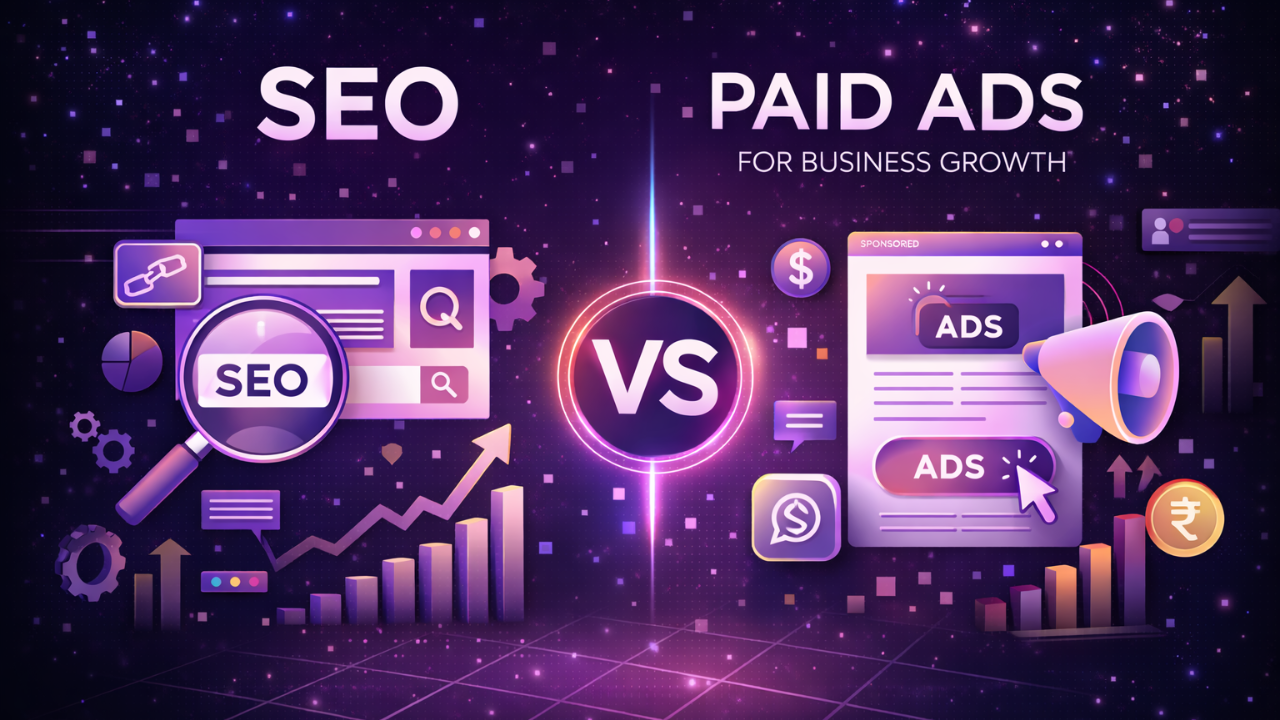
In today’s competitive digital landscape, every business faces a critical decision: should we invest in SEO or Paid Ads for sustainable business growth? Both strategies drive traffic, generate leads, and increase revenue. However, the real difference lies in ROI, scalability, sustainability, and long-term profitability.
Below, we break down the comparison in detail and determine which strategy delivers stronger business growth, higher returns, and lasting market authority.
Understanding SEO: The Long-Term Asset for Sustainable Growth
Search Engine Optimization (SEO) is the process of optimizing a website to rank organically on search engines like Google. When executed correctly, SEO becomes a compounding digital asset that continuously generates traffic without paying per click.
SEO and Long-Term ROI
The greatest advantage of SEO lies in its long-term return on investment (ROI). Unlike paid advertising, where traffic stops the moment spending stops, SEO builds authority that continues delivering value for years.
- Zero cost per click
- Evergreen traffic generation
- Higher trust and credibility
- Better conversion from organic visitors
- Long-lasting rankings
Once rankings are achieved, the cost of maintaining them is significantly lower compared to recurring paid campaign expenses. Over time, the customer acquisition cost (CAC) through SEO decreases dramatically.
With SEO, we are not renting traffic — we are building long-term digital equity.
Understanding Paid Ads: The Immediate Traffic Engine
Paid Ads, including Google Ads and social media advertising, provide instant visibility. The moment a campaign goes live, traffic begins.
Short-Term ROI of Paid Advertising
- Immediate traffic generation
- Precise audience targeting
- Quick offer testing
- Rapid scalability
Paid traffic operates on a continuous investment model. The moment spending pauses, traffic stops completely. ROI remains directly tied to budget efficiency and campaign optimization.
Paid Ads are powerful for product launches, limited-time promotions, seasonal campaigns, and rapid market penetration. However, they do not create long-term digital authority unless combined with a broader strategy.
SEO vs Paid Ads: Direct Comparison for Business Growth
1. Cost Efficiency and ROI Over Time
SEO ROI
- Initial investment: Moderate to high
- Ongoing cost: Low to moderate
- Long-term returns: Compounding
- Cost per acquisition: Decreases over time
SEO builds momentum. As rankings improve, traffic grows organically without increasing proportional costs. After 12–18 months, SEO often becomes the highest ROI digital marketing channel.
Paid Ads ROI
- Immediate budget requirement
- Continuous spending model
- Linear returns
- Cost per acquisition: Stable or increasing
Paid Ads scale directly with budget. Increase spending, increase traffic. Reduce spending, traffic disappears. There is no compounding growth effect.
ROI Verdict: For sustainable profitability and long-term growth, SEO consistently delivers stronger cumulative ROI.
2. Long-Term vs Short-Term Results
Short-Term Impact: Paid Ads dominate when immediate leads or sales are required. Businesses seeking quick revenue spikes rely on paid campaigns.
Long-Term Growth: SEO builds brand authority, domain strength, and consistent organic visibility. Organic traffic continues generating leads even when budgets are adjusted.
3. Brand Trust and Consumer Behavior
Users trust organic search results more than paid placements. When we rank organically:
- Our brand appears authoritative
- Click-through rates improve
- Conversion rates increase
- Customer lifetime value strengthens
Organic visibility builds credibility. Paid ads build exposure. Trust significantly impacts long-term profitability.
4. Scalability and Growth Potential
Paid Ads Scalability
Paid campaigns scale rapidly. However:
- Competition increases cost per click (CPC)
- Margins shrink as costs rise
- Performance depends on budget consistency
SEO Scalability
SEO scales through:
- Content expansion
- Keyword targeting
- Authority building
- Technical optimization
As domain authority grows, ranking new content becomes easier and faster. Growth compounds rather than resets.
Cost Comparison Over Three Years (INR)
Paid Ads Model
- Monthly budget: ₹2,49,000
- Annual spend: ₹29,88,000
- 3-year total: ₹89,64,000
- Traffic stops if spending stops
SEO Investment Model
- Initial investment: ₹16,60,000
- Annual maintenance: ₹8,30,000
- 3-year total: ₹33,20,000
- Traffic continues beyond investment cycle
Over three years, the Paid Ads model requires an investment of approximately ₹89.64 lakhs, whereas the SEO model requires approximately ₹33.2 lakhs. SEO delivers sustainable traffic at significantly lower cumulative cost while continuing to generate returns even after reduced spending.
Risk and Stability Analysis
Paid Ads Risks
- Rising CPC
- Ad fatigue
- Platform policy changes
- Complete dependency on paid platforms
SEO Risks
- Algorithm updates
- Ranking fluctuations
- Competitive content growth
SEO risks can be mitigated through strong content quality, technical excellence, and strategic authority building. Long-term stability favors SEO.
Final Verdict: Which Is Better for Business Growth?
If the objective is immediate traffic and short-term revenue, Paid Ads provide instant acceleration.
If the objective is long-term authority, sustainable ROI, reduced acquisition costs, and scalable growth, SEO is the superior strategy.
The most effective approach integrates both. Paid Ads accelerate short-term revenue, while SEO builds lasting digital dominance. When comparing long-term ROI, cost efficiency, and brand equity, SEO consistently delivers greater lifetime business value.