
10 Proven Meta Ad Strategies to Scale in 2026
Learn how to scale your business in 2026 with 10 proven Meta Ad strategies focused on AI-driven campaigns, creative testing, full-funnel execution, and advanced tracking for higher ROAS.
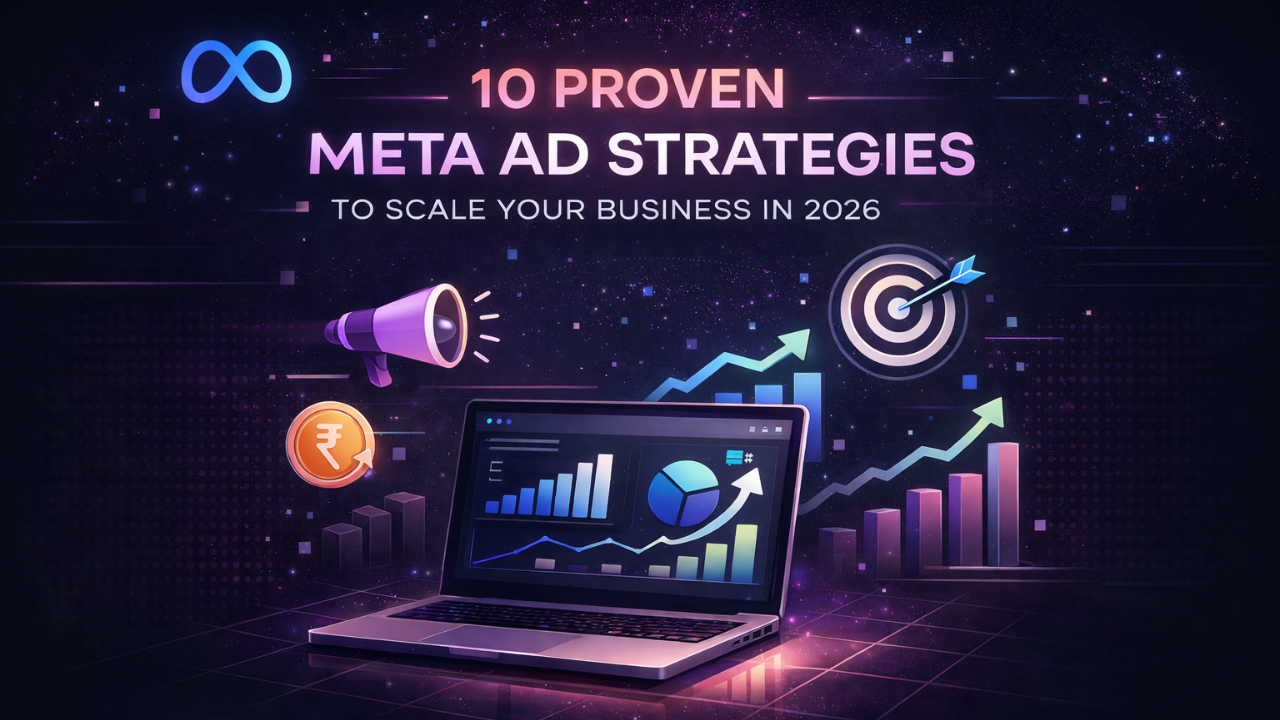
In 2026, Meta Ads remain one of the most powerful growth engines for brands that demand scale, precision, and profitability. With billions of active users across Facebook, Instagram, and the broader Meta ecosystem, businesses operate in an environment where data intelligence, creative dominance, and algorithm alignment determine success.
Meta advertising is no longer just a traffic source. It is a scalable revenue system. Below are 10 proven Meta ad strategies engineered to accelerate business growth in 2026.
1. Leverage AI-Powered Advantage+ Campaigns for Automated Scaling
Meta’s Advantage+ Campaigns are built for performance-focused advertisers. Manual micromanagement is outdated. Campaigns should be structured around broad targeting with AI-driven optimization, allowing Meta’s machine learning to identify high-value users.
- Use broad audience targeting with minimal restrictions.
- Optimize for purchase or highest-value conversion events.
- Feed the algorithm consistent conversion signals.
- Avoid over-segmentation that fragments data.
Allowing Meta’s AI to process behavioral and predictive signals at scale unlocks exponential growth potential.
2. Prioritize First-Party Data to Strengthen Targeting Precision
With global privacy updates, first-party data is the foundation of scalable Meta Ads. Build custom audiences using CRM lists, website traffic from Meta Pixel, lead form submissions, and video engagement data.
Deploy Value-Based Lookalike Audiences to replicate high-spending customer profiles. Instead of chasing impressions, engineer precision targeting based on lifetime value signals.
3. Engineer High-Converting Creative Variations at Scale
Creative performance drives results in 2026. Produce multiple creative angles per campaign including problem-aware messaging, solution-focused storytelling, testimonials, founder-led videos, and user-generated content.
Each campaign should contain multiple headline variations, primary text versions, and strong hooks within the first three seconds. Test thumbnails, captions, formats (Reels, Stories, Feeds), and placements across Facebook and Instagram.
4. Optimize for Conversion Events, Not Clicks
Traffic without revenue does not scale businesses. Structure campaigns around purchase optimization, qualified lead events, subscriptions, and high-intent micro-conversions.
Optimizing for link clicks is inefficient. Train the algorithm with high-quality conversion signals to attract buyers instead of casual visitors.
5. Implement Full-Funnel Campaign Architecture
Top of Funnel (TOF)
- Broad targeting
- Short-form video ads
- Educational content
- Brand positioning
Middle of Funnel (MOF)
- Retarget video viewers (25%, 50%, 75%)
- Showcase testimonials
- Handle objections with proof-driven creatives
Bottom of Funnel (BOF)
- Dynamic product ads
- Cart abandonment retargeting
- Limited-time offers
Controlling each stage of the funnel maximizes acquisition efficiency and reduces cost per acquisition.
6. Deploy Dynamic Product Ads for E-Commerce Growth
For online stores, Dynamic Product Ads (DPAs) are essential. Sync product catalogs directly to Meta to automate retargeting of viewed products, cross-selling related items, and upselling premium versions.
Dynamic ads personalize messaging based on user behavior, driving higher return on ad spend (ROAS). Optimize feed quality with strong titles, benefit-driven descriptions, and high-resolution visuals.
7. Utilize Advanced Audience Layering for Precision Targeting
While broad targeting works effectively, layered audience testing reveals profitable micro-segments.
- Interest stacking
- Behavioral filters
- Purchase behavior audiences
- Industry-specific lookalikes
Maintain sufficient audience size to avoid disrupting the learning phase. Balance granularity with scalability.
8. Master Budget Scaling Techniques Without Performance Drops
Scaling Meta Ads requires controlled execution. Avoid sudden budget spikes. Instead:
- Increase budgets by 20–30% incrementally.
- Scale horizontally through duplicated ad sets.
- Use Campaign Budget Optimization (CBO).
- Duplicate winning creatives strategically.
Monitor frequency, CTR, conversion rate, and cost per result. Refresh creatives immediately if performance declines.
9. Retarget Strategically with Segmented Messaging
Segment retargeting audiences based on recency and behavior:
- 1–3 day visitors
- 7-day visitors
- 14–30 day visitors
- High-value page viewers
Recent visitors receive direct offers. Older audiences receive trust-building content and testimonials. This structured segmentation increases conversion rates and reduces ad fatigue.
10. Integrate Meta Conversion API (CAPI) for Data Accuracy
Server-side tracking is mandatory in 2026. Integrate Meta Conversion API (CAPI) to improve event tracking accuracy, reduce browser data loss, strengthen attribution, and enhance campaign optimization.
Combining Meta Pixel with CAPI ensures reliable data flow, improving learning stability and overall performance.
Advanced Optimization Techniques for Meta Ads in 2026
Creative Hook Engineering
The first three seconds determine ad success. Use bold claims, dynamic visuals, and emotionally compelling openings to capture attention instantly.
Placement-Specific Creative Adaptation
Reels require fast-paced vertical videos. Feed placements demand strong thumbnails. Stories require direct-response messaging. Tailor creatives to match placement behavior.
Lifetime Value Tracking
Evaluate 30-day and 90-day customer value instead of focusing only on first-purchase ROAS. This supports sustainable scaling decisions.
Testing Framework Discipline
Isolate variables. Test one creative angle per ad set. Maintain controlled budgets. Make scaling decisions based on measurable performance data.
Meta Ad Strategy Framework for Sustainable Growth
Successful Meta Ads systems are built on four pillars:
- Data Intelligence
- Creative Excellence
- Algorithm Alignment
- Conversion Optimization
Each campaign iteration improves targeting accuracy, reduces CPA, and increases ROAS, making scaling predictable and sustainable.
Common Mistakes to Avoid in 2026
- Overcomplicating targeting
- Ignoring creative refresh cycles
- Scaling budgets too aggressively
- Optimizing for vanity metrics
- Neglecting server-side tracking
Meta Ads in 2026 reward businesses that combine data precision, creative authority, and AI-powered automation. By implementing these strategies, brands can scale predictably, reduce acquisition costs, and dominate competitive markets.